Pages

Custom Search

Product Testing Vs Application Testing

Product Testing Vs Application Testing

On the surface, there are few differences in terms of skills required to do product testing compared to application testing, except perhaps extra diligence and an eye for detail. However, some of the differences between product and application testing are as follows:

  • Software products need to work on a variety of environments and are expected to work on supported configurations of all supported platforms. This involves running of compatibility tests against supported operating systems and software that must co-exist with the product. This also involves repeating the same tests a number of times and is a fantastic argument for automation.
  • Products must be intuitive to use and work in a similar manner to other products in its domain. Moreover, products are used by a large number of end-users and the way different users use it, is liable to vary. Application users are typically instructed on how to use the application and how not to. Therefore, it's generally alright if an application is shipped with some bugs in it. For products however, usability and stress testing are of utmost importance and it means that there needs to be a user advocate who tests a product with an end-user in mind.
  • Software products also tend to have regular upgraded releases, with enhanced functions which should not break any existing product functionalities. This requires efficient regression testing.
  • The product management team collates frequently changing customer requirements and market expectations of a product, while also contributing to the product roadmap. As a result, the scope of the product changes constantly and testing becomes complicated with daily builds involved.
  • Product management's intervention in scope changes becomes more pronounced in agile environments while management thinks that by using agile the product can be taken to market faster. However, agile testing by itself is a specialized area and with requirements being added or modified constantly, testing becomes a complex process.
  • In some cases, when any bugs are found in a product after a release happens, they are taken as feature additions for the next product version and made as change requirements. In the case of an application, a customer can provide change requirements as bugs and construe it as a gap in understanding the requirements.
  • If a product is to be delivered as a plug-n-play solution to end-users, testing becomes straightforward as there are no multiple configurations and environments involved.

This is just a high-level overview of the differences between product testing and application testing.


Tags:

difference between application testing and product testing

product testing vs application testing

difference between project product testing

difference between mobile testing mobile application testing

difference between software application software product

difference between application development and product development

difference between application testing and system testing

difference between web testing application testing

what is the difference between calling a function and reusing an action

product testing

product testing definition

product testing process

software product testing

application testing

application testing methodologies

application testing process

application testing services

web application testing

software testing

mobile application testing

application testing checklist

application testing tools

Future of Test Automation and infrastructure

Future of Test Automation and infrastructure

Where were we and where are we today in automation?

Software provides the core functionality of most electronics products. These "software-intensive systems" have a large penetration into daily life and this penetration is expected to grow even more in the coming years. In addition to the growth in size and complexity, these software systems need to be of ever increasing quality and need to be developed in ever-shorter time frames. To tackle these increasing quality requirements, testing is an important step in the development of a software-intensive system, as it checks if requirements to a system have not been met. To remain competitive in the development of these systems, industry needs to increase productivity by means of better testing practices.

Starting from the initial stage of testing where automation tools were not available rather the dependency was highly on the unit tests performed by Developers and then manual testing by QA engineer. In Automation we have evolved from Core framework to Record and playback to Custom frameworks. And in custom frameworks, one starts to build the frameworks like Modular framework, Data Driven framework, keyword Driven framework, model based framework and eventually end up with to Hybrid framework solution. However the need has grown from these tool bounded scripts to easily understandable one's, for e.g, like for non-coders like business analysts.

This need gave birth to newer type of framework which has evolved out of the weakness of Test Driven Development (TDD), called Behavior Driven development (BDD). BDD covers the response to the issues encountered in test-driven development:

  • Where to start in the process
  • What to test and what not to test
  • How much to test in one go
  • What to call the tests
  • How to understand why a test fails

BDD covers the 'desired behavior' which has business value for whatever entity commissioned the software unit under construction.  There are many tools which are available in the market to support BDD, such as JBehave, Cucumber and Twist etc. Even after this advancement in testing, the question which still remains at large it, what is there in future for automation? To answer this we need to first understand what is in progress in software industry that requires immediate futuristic attention to address this question.

Smart UI Application Progress

Intelligent applications are aggressively occupying the smart applications running hardware which are now a day's commonly visible on smart phones, PC, TV, games consoles etc. Smart applications such as drawing based, security based, motion sensor based have become new vertical in software development and testing. Due to humongous rise in demands of such devices and software, this has given rise to boom in the software industry. Consequently this has enabled and influenced us to write software for smart mobiles and portable devices.

Software Test automation needs to support smart UI Applications

In order to support such smart UI applications, we definitely need to test them, and in order to test them we definitely need to perform test Automation to eventually support such technology. Consecutively our innovation must also work in this direction of development of such tools which support and drive.

What is expected?

Hence there is need for new level of test automation products that can reduce the cost of implementation and ownership so that you can focus on testing your application instead of developing your tests. These tools should provide a pre-written test framework that can substantially reduce — or even eliminate — the need to learn and use scripting languages.

Such test frameworks, should have the capability to:

  • Make automation accessible to testers who aren't programmers
  • Simplify script development
  • Reduce the maintenance effort

It could be possible that most of these frameworks can be wrapped around one or more existing commercial/freeware test tools, but not always. The primary difference among the products relates to their underlying execution "engine" or script library and whether it is mapped to action words, windows, objects or classes.

Vision for Future of Automation

On following few good practices, the future of test Automation and test automation management can be in good state:

  • Quality of test code should be good for production. Means, Use Private/ Protected member variables /methods. Make them public only when required
  • Traceable and Making Debugging Less Painful

Test automation management tools should ease the process of debugging by providing useful information and have all relevant references in one place.

  • Import only those classes which are required
  • Carefully Use xPath feature, lesser use or avoid Indexes.
  • Keep test data separate from test scripts.
  •  Valuable Reporting

Test automation reporting should be meaningful and flexible to both test engineers and IT managers. An outstanding management tool provides metrics such as trend analysis and key performance indicators for high-level decision making. Meanwhile, it should also have low-level log and statistics that are useful for debugging and internal analysis.

  •  Instant Recognition of Changes in Testing Results

It is essential now to pick up changes in automated test results almost immediately, which requires the management tool to shift information and improve test efficiency.

  •  Compliance with Testing Systems

Easy integration with other systems will help manage different tasks on a single platform.


Tags:


future of automation testing

tools of automation testing

why automation testing is needed

what is meant by automation testing

does automation replace manual testing

automated testing wikipedia

automated software testing

latest trends in test automation

test automation introduction

latest trends in test automation

latest trends process automation

challenges in test automation

benefits of automation testing

why we use automation testing

tools of automation testing

does automation replace manual testing

advantage of automation testing over manual

test automation process

Mobile Testing

Mobile Testing

Exponential growth of Smartphones has opened newer avenues for enterprises to integrate them into mainstream computing. Enterprises across all industry verticals are embracing mobility at a rapid pace.

According to Gartner's report on Market Insight 2012, Bring Your Own Device (BYOD), the rapid ascent of enterprise application stores, and the high expectations customers have of continual mobile app usability and performance improvements are just three of many factors driving mobility growth.

Enterprise applications that were initially available as web applications are now being ported to mobile devices.  Enterprises are now deploying mobile applications in empowering workforces in areas like Sales, Supply Chain, Field Support and Shop Floor.

Mobile testing is quickly becoming a necessity as more and more businesses are embracing mobility.  Mobile apps reflects the face of the enterprise, bad quality mobile apps can severely affect the reputation of the overall company.  Even smaller issues can negatively impact the brand. For example, according to research cited by Aberdeen senior research analyst Jim Rapoza, 7% of users abandon applications after just one second of delay in performance. 11% abandon at two seconds, 18% at three, 25% at four and 50% at five seconds.

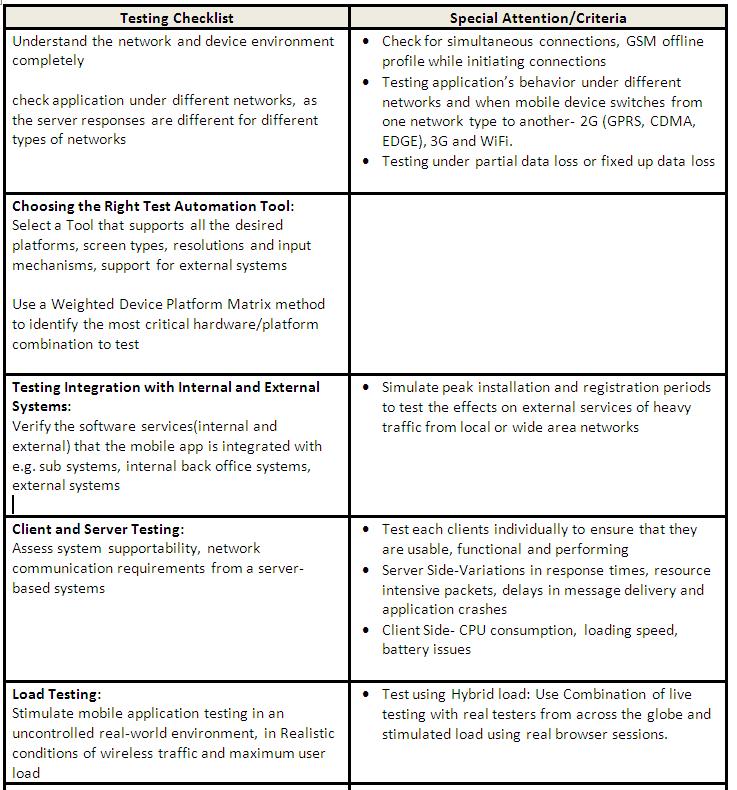
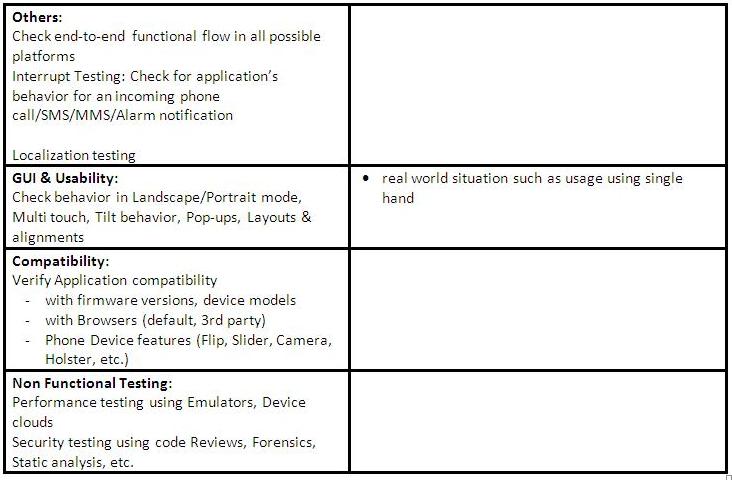
In Mobile application testing, there are unique challenges that are encountered like device and OS fragmentation, browser compatibility, UI compatibility, differences in the graphics and screen density of various devices.  There are various forms of bugs that affect mobile apps testing including minor flaws related to incoming calls, power cycles, low signal strength, form factors variations, bandwidth issues, network speeds, recording user actions and input errors.

The complexity of testing mobile devices is that there is code on mobile devices, especially in business apps, code runs on several servers and in backend data centers. The system must be active to test the code on mobile devices.  Setting up multiple infrastructures to test on mobile devices is an expensive proposition that customers would not prefer.   The technique is to isolate the different tiers of applications and stimulate a whole data center running.  The Test Engineer can virtualize and stimulate, allowing him to concentrate only on the mobile device and forget about all the backend stuff.

Automation tools available for testing:

Mainly mobile testing is done manually on actual devices. Some of the following tools are available in to test the functionality as well as usability of application.

-    Robotium for Android

-    Testquest, try, and digia for Symbian

-    FoneMonkey for IPhones

-    Memory sweep for IPhone

-     Other tools: eggplant, VNC Robot, Hopper and TestQuest

Performance/load and stress testing tools

-    Recent announcement by MicroFocus about SilkPerformer 9.0 (2012)  supports Mobile Web & Native apps testing on iOS, Android & BB platforms

-    HP LoadRunner supports mobile web & native apps testing on iOS, Android, BB & WM platforms

-    NeoLoad supports mobile web & native mobile apps

-    JMeter supports mobile web app testing on simulators

-    IBM Rational Performance Tester (RPT) supports mobile web app testing as well


Tags:

mobile testing

mobile testing tutorial

mobile testing tools

mobile testing interview questions

mobile testing jobs

mobile testing ppt

mobile testing wiki

mobile app testing

mobile software testing

mobile automation testing tools

mobile testing tutorial

mobile phone testing tools

mobile application testing

mobile testing interview questions

mobile testing tools tutorial

mobile app testing tools

mobile testing tools free download

mobile testing tutorial pdf

mobile testing interview questions

mobile testing tools

java mobile application testing tutorial

java mobile application testing example

mobile application development tutorial

mobile testing pdf

mobile testing techniques

mobile application testing techniques and tools

software testing techniques

mobile testing methodologies

mobile testing tutorial

mobile testing tools

mobile testing interview questions

mobile testing interview questions and answers pdf

mobile testing tools

mobile testing tutorial

mobile testing interview questions with answers

mobile apps testing interview questions

mobile application testing interview questions

mobile application testing interview questions and answers

mobile app testing interview questions

test cases mobile application testing

iphone testing interview questions

mobile application testing tutorial

interview questions handset testing

mobile application testing tools

mobile application testing ppt

mobile application test cases sample

windows mobile test cases

automation tool test cases

android test cases

mobile application testing

test cases for mobile

test cases for mobile phone

Automated Regression Testing Challenges in Agile Environment

Agile Projects present their own challenges to the Automation team; Unclear project scope, Multiple iterations, Minimal documentation, early and frequent Automation needs and active stakeholder involvement all demand lot of challenges from the Automation Team.Some of these challenges are:

Challenge 1: Requirement Phase
Test Automation developer captures requirements in the form of "user stories", which are brief descriptions of customer-relevant functionality.

Each requirement has to be prioritized as follows:

High: These are mission critical requirements that absolutely have to be done in the first release
Medium: These are requirements that are important but can be worked around until implemented.
Low: These are requirements that are nice-to-have but not critical to the operation of the software.

Once priories are established, the release "iterations" are planned. Normally, each Agile release iteration takes between 1 to 3 months to deliver. Customers/software folks take liberty to make too many changes to the requirements. Sometimes, these changes are so volatile that the iterations are bumped off. These changes are greater challenges in implementing Agile Automation testing process.

Challenge 2: Selecting the Right Tools

Traditional, test-last tools with record-and-playback-features force teams to wait until after the software is done. More over, traditional test automation tools don't work for an Agile context because they solve traditional problems, and those are different from the challenges facing Agile Automation teams. Automation in the early stages of an agile project is usually very tough, but as the system grows and evolves, some aspects settle and it becomes appropriate to deploy automation. So the choice of testing tools becomes critical for reaping the efficiency and quality benefits of agile.

Challenge 3: Script Development Phase

The Automation testers, developers, business analysts and project stakeholders all contribute to kick-off meetings where "user-stories" are selected to next sprint. Once the "user-stories" are selected for the sprint, they are used as the basis for a set of tests.

As functionality grows with each iteration, regression testing must be performed to ensure that existing functionality has not been impacted by the introduction of new functionality in each iteration cycle. The scale of the regression testing grows with each sprint and ensures that this remains a manageable task the test team use the test automation for the regression suite.

Challenge 4: Resource Management

The Agile approach requires a mixture of testing skills, that is, test resource will be required to define unclear scenarios and test cases, conduct manual testing alongside developers, write automated regression tests and execute the automated regression packages. As the project progresses, specialist skills will also be required to cover further test areas that might include integration and performance testing. There should be an appropriate mix of domain specialist who plan and gather requirements. The challenging part in the Resource management is to find out test resources with multiple skills and
allocate them.

Challenge 5: Communication

Good communication must exist among Automation testing team, developers, business analysts and stake holders. There must be highly collaborative interaction between client and the delivery teams. More client involvement implies more suggestions or changes from the client. It implies more bandwidth for communication. The key challenge is that the process should be able to capture and effectively implement all the changes and data integrity needs to be retained. In traditional testing, developers and testers are like oil and water, but in agile environment, the challenging task is that they both must work together to achieve the target.

Challenge 6: Daily Scrum Meeting

Daily Scrum Meeting is one of the key activities in Agile Process. Teams do meet for 15 minutes stand up sessions. What is the effectiveness of these meetings? How far these meetings help Automation practice Developers?

Challenge 7: Release Phase

The aim of Agile project is to deliver a basic working product as quickly as possible and then to go through a process of continual improvement. This means that there is no single release phase for a product. The challenging part lies in integration testing and acceptance testing of the product.

If we can meet these challenges in a well optimized manner, then Automated Regression Testing in Agile environment is an excellent opportunity for QA to take leadership of the agile processes. It is better placed to bridge the gap between users and developers, understand both what is required, how it can be achieved and how it can be assured prior to deployment. Automation practice should have a vested interest in both the how and the result, as well as continuing to assure that the whole evolving system meets business objectives and is fit for purpose.

Transitioning from Waterfall to Agile Testing – ‘Challenges & Approach’

Transitioning from Waterfall to Agile Testing – 'Challenges & Approach'

More and more software projects in the mainstream are embracing Agile, these days.  It's important to understand how this paradigm shift impacts testing teams.  And, what are the challenges testing teams encounter and how do they overcome them?

This blog post is an attempt to answer some of the questions above by taking inferences from a recent customer engagement of Aspire, where Client's team and Aspire's offshore team collaboratively plans the move to Agile.

Driving the transformation to Agile Testing

Our customer is a leader in enterprise fraud management solutions in US.  This customer has been engaged with us for more than 6 years now.  Aspire is involved in Manual Testing and Test Automation of their suite of products.  Because of a heightened need for shorter testing cycles and higher visibility, customer decided to move ahead with Agile.

Primary Differences in working style- Waterfall Model vs. Agile

In the waterfall model, requirements along with product documentation were entrusted to the team.  There was enough time to understand requirements, perform exploratory testing, write test cases, and automate the QA.  On the Test Automation front, the builds were stable, with the UI and functionality intact, making it easier for preparing good test scripts.

All these practises that were working earlier were not applicable for agile approach. So the team decided to pursue each problem one by one and analyze the strategy for agile testing and define new methodologies.

The typical activities that were carried out include:

Requirements Understanding and Scheduling:

Less Documentation/Regular Communication Meetings: Meetings with the Product Owners, Scrum Masters and development team to understand the requirements one by one and validated our understanding by questioning defined Use Cases.  The requirements were approached from the customer perspective.

Refining the requirements from the customer perspective: The requirements were refined to the smallest possible unit.  This enabled the team to commit the unit requirement into specific Sprint.  Then the team proceeded onto writing test scenario with test cases as soon as the sprint started.

Estimate the effort required to complete the estimation: Based on the refined requirements, team was able to precisely estimate the effort required to complete the design, development, QA and documentation.  This helped everyone in the team to know when the preceding task (say development) would be completed and the work product would be available for succeeding tasks (say QA).  This helps to track the schedule and negate any slippage.

Test Automation:

Transition to Test Automation was not as easy as it was in manual testing.   Earlier, the team had a complete set of test cases and cushion of stable builds for categories like smoke and regression. This helped to create module based scripts with good reusability.

Development & Test automation in Different Sprint: Initially Test Automation was followed up by development activities and manual testing with a gap of one sprint.  The team automated test cases of previous sprint, so that the team can minimize test script maintenance activities.  Since this was not in tune with agile, we followed below approach.

  • Developing feature, writing test cases and creating test scripts went in parallel for a particular requirement.
  • Developer/Product Owner reviews the test cases based on scoped requirements
  • Test automation engineer starts writing stub test scripts and common functions based on reviewed test scripts
  • Transparent & Collaborative Approach: Since each member in the team was aware of the team member's work and this helped to inform the changes better and avoid any rework in the sprints. The integrated work-approach within the team played a crucial role here.

Regression testing:

Delivering working products faster requires shorter end of the release activities. So we need to minimize the end of release activities (specifically regression testing).  To accommodate this, we empowered our QA Infrastructure to perform regression quickly, as and when needed, without pushing it to the end of the release.

  • At the end of each sprint, the test cases (which are mostly automated) were classified into categories like sanity, smoke, regression etc.
  • The Smoke test cases in particular were executed as nightly tests which helped to uncover any major issues instantly.
  • Importantly, these test suites had to be properly maintained to have confidence in the scripts. So the testing team worked with developers to maintain these tests where they will review the scripts and will also execute the tests wherever they feel something has changed/affected.
  • This helped to extensively bring down the regression testing effort required at the end of each release

Certifying alpha / beta kits

  • In the earlier waterfall model, resources spent dedicated time to certify alpha and beta kits.
  • With the current approach in regression testing and test automation, qualifications of kit were integrated and were implied part of sprint deliverables.
  • Delivery of fully working product in each sprint

Team Work

All these need consensus within team that "Quality of product is every ones responsibility".  The emphasis has been on review of test cases and test scripts, involving ourselves in requirement grooming, giving feedback on usability and most importantly approaching testing with quality in mind.

Conclusion:

Agile helped us to improve ourselves and scale up in new areas. In the team, people who were used to performing manual testing alone, started developing automation scripts and reviewing scripts developed by others.

The team aggressively interacted and worked closely with developers and product owners.

And thus, they were able to deliver product quickly (~50% less time than waterfall model approach) and with good quality. Most importantly they are learning each day in agile and "Transforming Product Development".

Tags:

agile testing life cycle

agile testing methodology

agile testing ppt

agile methodology

agile testing process

agile model

agile testing scrum

scrum

agile testing

agile testing life cycle

agile testing scrum

agile testing process activities

agile testing process ppt

agile testing interview questions

software testing process agile development

agile testing process wikipedia

agile testing process examples

agile testing scrum ppt

what is agile testing scrum and sprint

testing agile scrum methodology

agile scrum testing methodology

what is scrum process in testing

agile test plan

what is agile methodology

scrum test plan

janet gregory agile test plan template

agile test plan template

quality assurance agile test plan

agile test plan forums

agile test plan quality methodologies

kind agile test plan

agile test plan sample

test plan in agile methodology

agile scrum testing process

agile testing process diagram

agile testing process ppt

agile software testing process

agile testing challenges

agile testing basics

agile regression testing

what is agile testing in software testing

agile testing process ppt

testing challenges in software testing

testing in agile environment

what is agile testing in software testing

regression testing in agile

define agile testing

agile testing benefits

role of tester in agile

gile test strategy

agile testing methodology wiki

testing agile scrum methodology

agile testing methodology tutorial

agile testing methodology diagram

performance testing agile methodology

agile methodology in software testing

agile model in testing


Agile Automation

Agile Automation

According to the World Quality Report 2010/2011 by Capgemini and HP over 60% of companies have either already adopted agile methods or are planning to do so in the near future.  Agile Testing has been gaining popularity over the last few years due to several reasons such as the faster product development lifecycles and quicker Go to market cycles (GTM.

Some of the factors that affect progress and outcome of sprints are:

  • Reduced Coverage: Compressed time frames in each sprint, forces the Test Engineers to test only the areas that have changed in the sprint.  A complete regression cycle is not being conducted on the rest of the application leaving it susceptible to major flaws
  • Traditional tools that were designed to work in a 'test last' environment, struggle to work in agile environment which is designed for 'test first, test continuously' model. New agile specific tools from Version One or Rally Software, can be used
  • Agile Testing allows requirements to creep in any time during any phase of the project and it will be accommodated in the already allotted functionalities to be validated

To address these issues, a suite of automated testing solutions can be formulated that enable smarter sprints that help to meet deadlines and timely qualitative releases.

And some of the best practices that can yield great results for such short GTMs and provide quick ROI are:

  • Refactoring/Regression-Performing  Bug fixes, refactoring old code and running extensive regression testing, every few weeks to focus on stability, takes care of missed bugs during ongoing testing process
  • Testing from a Customer Point of View: Sharing good stories with customer relevant material, with the development team as well as the testing team
  • Test ideas can be compiled in a presentation shared with the developers and developers can take live feedback helping developers start thinking about whether their software will pass such tests
  • Frequently run tests or procedures, or those that take the most time, if automated, can generate a big ROI

Adopting these core points can hugely impact the overall testing process.


Tags:

agile testing life cycle

agile testing methodology

agile testing ppt

agile methodology

agile testing process

agile model

agile testing scrum

scrum

agile testing

agile testing life cycle

agile testing scrum

agile testing process activities

agile testing process ppt

agile testing interview questions

software testing process agile development

agile testing process wikipedia

agile testing process examples

agile testing scrum ppt

what is agile testing scrum and sprint

testing agile scrum methodology

agile scrum testing methodology

what is scrum process in testing

agile test plan

what is agile methodology

scrum test plan

janet gregory agile test plan template

agile test plan template

quality assurance agile test plan

agile test plan forums

agile test plan quality methodologies

kind agile test plan

agile test plan sample

test plan in agile methodology

agile scrum testing process

agile testing process diagram

agile testing process ppt

agile software testing process

agile testing challenges

agile testing basics

agile regression testing

what is agile testing in software testing

agile testing process ppt

testing challenges in software testing

testing in agile environment

what is agile testing in software testing

regression testing in agile

define agile testing

agile testing benefits

role of tester in agile